
Many people come to Solo Jazz by chance: they discover it while learning Lindy Hop and wonder if it's worth spending time on. The short answer is yes. The long answer is this article.
Solo Jazz is a dance with over a century of history, deep African-American roots and a way of understanding movement that goes far beyond learning steps. Here I explain what it is, where it comes from and what values define it.
Table of Contents
What is Solo Jazz?
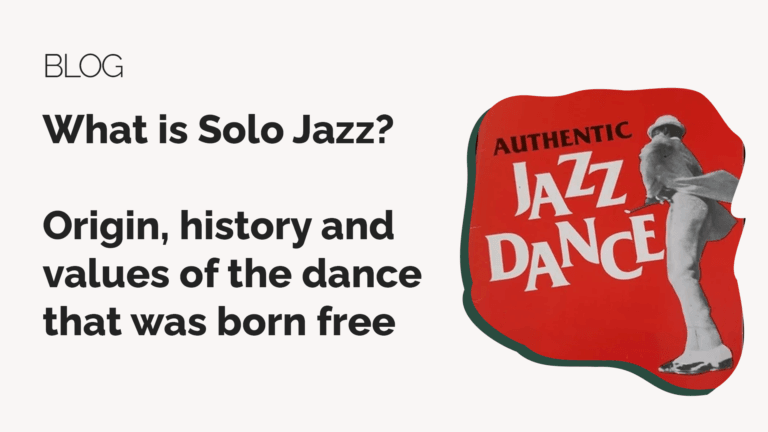
The Solo Jazz, also known as Authentic Jazz or Jazz Roots , is a dance that has its roots in the Afro-American culture. This dance style developed in parallel with jazz music, especially during the 1920s, 1930s and 1940s in the United States. It is characterised by its improvisation and freedom of movement.
Contrary to what many people believe, it is not a ballroom dance or modern jazz. It is a folk dance, social dance, which emerged from the people and was passed down from generation to generation orally and physically, initially without academies or books. It was learned by watching, imitating and adding one's own personal flavour.
It is, in essence, the body responding to jazz music with complete freedom.
An individual dance with community spirit
It is an individual dance, a priori, without physical connection to another person, unlike Lindy Hop, for example, which is a partner dance. This allows us to learn Solo Jazz without the need for another person. However, it is a dance in which the community aspect is very important. It is often danced in jam circles1, a space for support and spontaneity , created on the dance floor where jazz lovers can improvise and offer friendly challenges to other dancers. During jams, you can play various games such as call and response, drawing inspiration from the movements of other dancers...
Nowadays, most of us start by learning Lindy Hop, attracted by the pleasure it brings us and the opportunity to share, connect with others, and be part of a community.
However, from my point of view, it would make more sense to start with Solo Jazz or, at least, work on it in parallel. In this way, you would first learn to move your own body, gain spontaneity, listen to music more deeply and express it more freely.
Roots and historical evolution of Solo Jazz
The Solo Jazz has its roots in West Africa. During the transatlantic slave trade, millions of Africans were forcibly brought to America, bringing with them their cultural traditions and dances. These practices—polyrhythm, improvisation, use of the body as an instrument, and the direct relationship between music and movement—fused with local elements, giving rise to a unique African-American culture. When jazz music was booming in the 1920s and 1930s, Solo Jazz developed in the clubs and dance halls of cities such as New York and Chicago.
Solo Jazz was a dance that attracted both contempt and admiration: its energy and sophistication aroused fascination, while in a deeply segregated society, it also generated racism, exoticisation and cultural appropriation without recognition of its African-American origins.
Starting at the beginning, the earliest foundations of Solo Jazz can be found in the Pattin’ Juba (18th–19th centuries), a body percussion dance based on clapping, body slapping and complex rhythmic patterns. Juba allowed African musicality to be preserved in a context where drums were banned, and established the rhythmic logic that would later define tap and jazz dance.
Excerpt from the documentary Sprit Moves. Performance of Cake Walk, danced by Leon James, Al Minns, Pepsi Bethel, among others.
In the mid-19th century, the Cake Walk, created by enslaved people as a parody of European ballroom dances. Its popularity in white shows made it the first widely disseminated African American dance. It introduced theatricality, exaggeration and contrast, elements that would later reappear in the vocabulary of jazz.
Between the late 19th and early 20th centuries, Tap dance, the result of a fusion between African-American Juba and European step dances. Tap brought rhythmic sophistication, improvisation and advanced physical musicality, directly influencing the rhythmic structure of Solo Jazz.
At the same time, between 1900 and 1920, the "animal dances”, a series of African-American dances inspired by animal movements — such as the Turkey Trot, Grizzly Bear, Bunny Hug or Camel Walk— which incorporated humour, exaggeration, body isolation and syncopated rhythms. These dances broke with the rigidity of European ballroom dancing, normalised free and expressive movement, and paved the way for the vocabulary of jazz. Although they emerged in African-American communities, many of these dances were quickly appropriated and commercialised in white circles, often stripped of their original cultural context.
In the 1920s, the following appeared: Charleston and the Black Bottom, urban African-American dances that added energy, marked syncopation, grounded movement, and foot patterns that were integrated into the Solo Jazz vocabulary. These styles were the immediate bridge between earlier African-American forms and the birth of Solo Jazz.
The Solo Jazz from the 1920s to the 1940s is the synthesis of this entire process: it inherits the polyrhythm of Juba, the theatricality of Cakewalk, the musicality of tap and the energy of Charleston and Black Bottom. Its identity is based on improvisation, syncopation and a repertoire of individual steps that reflect more than a century of African-American cultural evolution.
Values and principles of Solo Jazz
The Solo Jazz (Authentic Jazz) is not just a technique or a repertoire of steps; it is a way of understanding movement and music. The fundamental values of this dance are:
- Musicality
Dance with the music, not ‘on top’ of the music. Listen to accents, silences, breaks, swing, and let your body express or complement it. - Expressiveness
Solo Jazz is communication. It involves attitude, character, humour, elegance or mischief. It is not neutral. - Individuality
It is a space for individual expression. Although we share a common language (steps vernaculares), we value each person's unique personality. - Community and exchange
Even though it is ‘solo,’ it is born in social spaces (ballrooms, clubs, jam circles). There is dialogue, mutual inspiration, and shared energy. - Improvisation
Ability to create in the moment. Even though we learn routines, the essence is to play with what happens live. - Rhythm and groove
It is a very rhythmic dance. The body is connected to the floor, with polyrhythm and swing. - Healthy competition and play
The tradition of jam circles and cutting contests, very much in evidence during the swing era. Competing was also a way of celebrating and learning.
Solo Jazz is freedom with roots, expression with rhythm, and community through individuality. If you recognise yourself in any of these values and already have a foundation in dance, the Advanced Solo Jazz Course – Rhythm and Essence on Swing Dance Home is designed precisely for this purpose.
Solo Jazz, Authentic Jazz or Vernacular Jazz: what is the difference?
A priori, we could say that we dance Jazz, plain and simple, or Jazz on our own; therefore, Solo Jazz.
But in the 1950s, the term "Authentic Jazz" became necessary to distinguish the two dance styles. The first celebrates the cultural roots of jazz, with relaxed improvisation alternating with fast footwork, call-and-response elements, syncopation and riffs. The second, Modern Jazz, was an emerging trend that incorporated classical ballet techniques and other more contemporary ones, with stylised lines that moved away from the vernacular traditions of Jazz.
The rise of Modern Jazz led to African-American dancers and choreographers, such as Pepsi Bethel, seeking to preserve the authenticity of the original movements. In this context, Bethel was one of the promoters of the term "Authentic Jazz” to differentiate this vernacular tradition from the stylised trends of Modern Jazz, thus reclaiming its African-American cultural roots and historical continuity.
In recent years, Moncell Durden, a scholar of African-American dances of the diaspora, has pointed out that, in reality, this form of dance is simply Jazz, and that it was Modern Jazz that needed to differentiate itself as another genre. From this perspective, adding ‘Solo’ or ‘Authentic’ may be unnecessary.
Within the community of Jazz and the Lindy Hop, where we share common references and codes, we can simply say Jazz and understand each other perfectly. However, in this informative article, I have decided to use mainly the term Solo Jazz to situate myself more accurately in history and avoid contemporary confusion.
The name matters because it reminds us where this dance comes from and what history we are continuing every time we dance it.
Can I learn Solo Jazz without knowing Lindy Hop?
Yes, absolutely. Solo Jazz is a dance in its own right, with its own language and its own pleasure. It is not a complement to Lindy Hop — although it enriches it — but a discipline that you can learn from scratch, even if you have never danced swing before.
In fact, as I mentioned earlier, there is a strong argument for starting here: first learn to move on your own, to listen to the music and express it with your body, before adding the complexity of dancing with a partner.
Summary
Solo Jazz is not just a repertoire of old steps or a technical discipline. It is a living tradition that connects history, music and community. Understanding its origins, values and name allows us to dance it with greater awareness and respect, knowing that each step is part of a story that continues to evolve.
Would you like to give it a try? At Swing Dance Home, you can start with your first Solo Jazz class for free.
1 In my opinion, currently two types of jam circle exist. On the one hand, there are those in which only one dancer or a pair comes out into the middle of the circle to show off their skills while the rest stand outside supporting and applauding. On the other hand, there are Solo Jazz jams where all the dancers dance at the same time or take turns exchanging phrases, but it is not necessary to go to the middle. From my point of view, this second type of jam circle is more community-oriented and allows for more sharing of the dance and enjoyment together.
Further information:
- An article about "Jazz dance" in the Encyclopedia Brittanica
- Authentic Jazz: History and Nomenclature – Crazy Legs Chile
- The history of Authentic Jazz dance (Part 1) – National Jazz Archive
- The history of Authentic Jazz dance (Part 2) – National Jazz Archive